
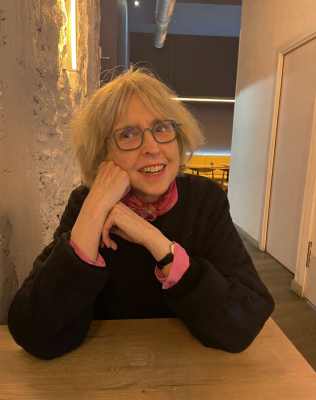
Rosemary Jones
creative nonfiction
Rosemary Jones was born in Australia and lives in Connecticut. Her essays and stories have appeared in Creative Nonfiction, Cimarron Review, Cleaver, Sweet, Denver Quarterly, Sonora Review, Brilliant Flash, The Forge, and is forthcoming in Ghost Moth Review and Ragaire Literary Magazine. Her work has been nominated for a Pushcart prize, awarded an Alligator Juniper prize for nonfiction, and listed as notable in Best American Essays.
X-ray Eyes
I’m lying on a daybed in my father’s medical rooms and meant to be reading Shakespeare’s Corialanus for a coming English tutorial. It’s my first year at university. I don’t care a whit about the characters but I drag my eyes across the page. Dad has taken an x-ray of my ankle, which I’ve hurt after an expedition to the hills with a couple of friends when one of them pushed me into a stream and my foot smashed against a rock. He’s heaved the leaden apron around my neck to protect me from radiation, disappeared behind a screen, called out to hold still as the machinery clicked and hummed. Green liquid now bubbles around the developing film. Smells of chlorine and chemicals waft out from the dark room. The negative, clipped to a metal frame, is being dipped into the developer and fixer, rinsed, then on to the finisher and the next stage where the roar of a small wind sets it to dry.
At last, the x-ray is ready to read. I hobble in on crutches and stand in the doorway. Dad sits on a stool holding the 11x17-inch film in his right hand between thumb and fingers. The photographic sheet wobbles. All bones and emptiness. The white of his coat—I think he’s wearing a white coat, certainly on other visits he wore his white coat. Maybe he wears a checked shirt, the checks small and definite, and pants, and hush puppies rather than leather business shoes because it’s the weekend. He’s still so young. His hair brown. He’s relaxed. In his element, though I don’t recognize this then. I’m impatient to get out of there.
He swivels around on the stool to flip a switch. A fluorescent light blinks and settles on the backlit screen above his desk. In his hand, the rectangle of film emits a low whoop-whup-wop, a bird finding its bass song far out on a still lake, before he locks it between his long fingers, clamping it to him like a temporary bodily attachment.
He holds the x-ray perfectly still, staring. With a minuscule muscle movement, a flick of his wrist, a snap but not a snap, an upward, decisive jerk of his hand pins it to the screen. He reads the image as if he’s listening to it sing, alert to anything less than perfect pitch. My knobby ankle. He scans. One second. I dare not ask a question. Not a word. Not an intrusion. Two seconds. He peers, blue eyes on the hunt for the faintest of lines, a crack in the bone. Three, four, five seconds pass and when he’s sure, he swivels around on the stool to face me.
“No break,” he says, without any humming and ahhing, no vocal warm-up or working of his lips as he usually does before making a decision.
“No break?”
“Torn ligament. Worse than a break, really.” There it is. His clear reading. Nothing to be done except hobble about for six weeks or so until it’s healed.
In that crisp fleeting moment before he pegged an x-ray to the glass lay the essence of my father’s attention. His probing eye. His desire for knowledge. His curiosity whittled to a fine, then finer point. Almost all my life, the x-ray and the wobble of sound it makes when gripped between thumb and fingers, has accompanied me. It doesn’t matter whose x-ray. It could be any one of a number in my family, the film contained in a large yellow-brown manila envelope before my father eased it out, holding it up to a light source to examine the greys and blacks and whites, as though they were vibrant with color variations and he noted every single one.
~
The Viennese artist, Egon Schiele, captures some of the x-ray’s history in a portrait of his friend, a gynecologist, Dr. Erwin von Graff.1 At an exhibition at the Neue Galerie, the painting shows a man with a rectangular head and a long neck, dressed in a white, short-sleeved shirt rising almost to his chin. Over the shirt, a cream vest—made of animal skin, the museum plaque says. He’s in a space with no particular background, perhaps placed against the white walls of a hospital room. One hand rests on his shoulder. One of his fingers is bandaged at the tip. Protecting his elbow, the fingers of his other hand spread wide, splattered with color. His gaze is scrutinizing, blue-eyed, intense. He’s almost my father but not enough of him to send a greeting. What I peer at most is not Dr. Graff’s gaze, a pulse of concentration just like Dad’s, nor van Graff’s vest, which is a more sophisticated version of my father’s pig-skin gardening vest, but his long, albeit motley-colored, scabby arms, and his long elegant hands. These remind me of Dad’s, though von Graff’s rosy, theatrical, pink fingernails and finger joints like balls of rust, do not. Pigments of color pool over von Graff’s formidable forehead as if to represent cogs of whirring brain power.
When I first saw this painting some years ago, I thought this was Schiele being Schiele, experimenting with the complex textures of human skin. But actually, the skin drama points to the effect caused by the process of x-raying: radiation dermatitis. In those days, a real and horrible effect of working with x-rays and a consequence of radiation therapy now. Not that my father ever endured either.
I don’t immediately warm to Dr. Erwin von Graff. Perhaps it’s his dictator-like moustache. And I’m not entirely comfortable that he allowed his young friend Schiele access to the female patients in his hospital. Schiele portrays them in varying stages of pregnancy and distress, the conditions, circumstances, and painful etceteras of their lives peeled away to show haunting images of women’s bodies afloat on the canvas. But the women look straight at us. An intimacy and something disturbingly, almost tangibly alive connects us and them. So, my quibble with Dr. von Graff is ameliorated, helped by knowing the doctor eased Schiele’s death during the great influenza epidemic when he died, aged 28, just three days after his pregnant wife. And I admire the doctor’s bravery in using radiation to help guide radiology forward. I didn’t know until later in Dad’s life that he was one of the first radiologists to bring mammography to South Australia. Once, experimenting with techniques to best capture an image of a breast, he used a cow udder he’d acquired from the Gepps Cross abattoirs. I imagine he thought he should consider any angle that might help. I imagine my mother’s response, “Well dear, if you think it will be of benefit.” Outlandish perhaps, but maybe worth the trouble. Did it help? I don’t know.
~
After my mother fell in her eighties and before everything went skittering and whispering into disarray, Dad and I and my children visited her at a hospital where he’d once practiced. As we approached, a sign appeared: Dr. Jones & Partners. He’d never said much about it, but the signage popped up in the city at a few clinics. Where before a long list of names had reflected a partnership built over the years, now the shingle came down to just one name: his. My mother had reported the news of this renaming to my siblings and me. We’d smiled, impressed, knowing it was a mark of respect for him after he retired: it wasn’t a money transaction. He’d looked pleased, a little surprised. Without my mother mentioning it, he may have said nothing. As he walked along with his stick this particular day, shyly he pointed to the sign.
“See that? That’s me,” he said.
“You, Grandpa?” Isobel’s eyes lit up. Charlotte skipped along beside her. Yes, yes, it was he. He gave a quiet smile and we walked through the doors and up to my mother’s floor.
~
At the public infant school I attended, one morning recess time I asked a tearful boy if he was all right. He pushed me away onto the warm asphalt. When I got to my feet, the playground, the shelter shed filled with hard benches where we ate our home-packed lunches, and the crate of glass milk bottles glinting their silver foil tops, swung out of focus. My left arm hurt. Afterwards, I sat light-headed in the headmistresses’ pale green office—or perhaps it was white and I simply felt green—until my mother came to take me home. She phoned our family doctor. I’d have to have an operation. An operation? The word sounded too large, too hefty. I sat in the kitchen while my mother cooked sausages in the electric frypan. No, I couldn’t have a glass of water, and no to a sausage. I was lightheaded and salivating. Dad arrived home and drove me to the Children’s Hospital. "Put your good arm around my neck,” he said. Though I was sure I could have walked, he carried me in his arms across Montefiore Hill Road to the yellow brick building with its curving balcony where ill children used to sit on sunny afternoons. In the operating room, a white-coated doctor stood at my head clamping a mask of ether over my face. I don’t like the smell of this, I thought too late to say, and too frightened. He set my arm in plaster and after I was home again a couple of days later—two nights too long!—the iron bed, the smell of disinfectant, the bright white shoes of the nurses, the strangeness of being alone without my family, all followed me. I poked one of my mother’s knitting needles down the plaster each time my skin itched, which was often. And I heard the wobble of an x-ray.
~
The word x-ray carries a soundtrack. Acoustics in the hand as familiar as the tap of a typewriter. Not the sound of the actual machine, I don’t mean that. Rather, the low woof and whump of an x-ray briefly juddering before fingers still it. Before an assessing eye pursues a crack, a fissure, or gleans a patch of something amidst a sea of dark. Before that eye divines the secrets of the black and silver bromide map. And before the mutterings begin that might accompany a diagnosis. “Hmm, hmm, w-e-ll . . .” A throat noise, a cross between a growl and a rolling revving hum, a voice tuning up, a hesitation until the arrival of vocalized certainty.
That quest for the truth of things. It’s there in Dad’s copy of Gray’s Anatomy. This is the 1947 edition, the blue binding worn, the pages striped with underlinings in red and blue pencil. After Dad retired, the tome sat in the bookshelves near the coffee table where my daughters spread the Legos kept especially for them when they visited. Sometimes, he pulled out Gray’s Anatomy to consult during our visits.
Handwritten yellow sticky notes bookmark some of the pages. Take “The Bursae” for instance, page 652; “Leg Nerve Areas,” page 1186; and page 1168, where a paragraph discusses the lateral popliteal nerve in the foot and the anterior tibial nerve (he had such trouble with his feet). On the opposite page, a diagram of a foot peels away the skin to reveal ribbons of tendons and abductors, and I wonder if I should study this for my own feet, mildly in trouble as I grow older. I see him wearing his gold-rimmed reading glasses, poring over the pages, doctorly thoughts tumbling. When I look now, none of the underlined sections on the brain have a yellow sticker. When it came to the brain, his in particular, what would have been the point? The damage done.
~
My parents met as members of the Student Christian Movement (SCM) at the University of Adelaide, a movement that had less to do with attending church and more to do with pursuing social and economic justice. They’d go on to build their lives on the principle of that movement (atheists, both) to do good in the world. In a letter written to my father when he was away for three months studying for the radiology exams in Melbourne, away from my mother, away from their four-month-old baby and after my father had returned home for a brief weekend visit, she said how much she longed for his presence, his arms, his voice. And she was sure they’d build on their love, the old and the new, to develop themselves and their personalities so they could give more to each other and the world. She was twenty-six. Cognizant then, that together they could be a force.
While I haven’t always reckoned with the significance of the SCM, its principles carried through both my parents’ lives: my mother to study women’s history and through her research pull unseen women into the public eye, and my father with his dedication to sound radiological practice to draw to the surface what was obscure. It seems so simple now. Of course, it was not.
~
When we reached the cusp of puberty, out of curiosity my father took an x-ray of each of our hands. This was for the express purpose of calculating our prospective heights when we emerged into adulthood.
A Saturday afternoon. Hand placed on a silver metal plate, fingers spread. Dad playing radiographer (he loved the radiographers with whom he worked, their smarts, their deftness in angling the body of a patient), disappearing to operate the machine, his voice calling into the darkened room, “Hold still, don’t move!” Then the whirr, the world outside vanishing, absorbed for those minutes into a dim uncanny peace.
Dad’s calculations were mysterious. But he produced a number, an estimate; we’d be this height, or that. I can’t remember what he thought I’d be. As a child, I’d shot up so fast my parents may have worried I’d be “too tall.” Too tall for a woman, that is. His guess? I’d be tall, but not all that tall. A good height, he decided, pleased with himself not that he could make an educated guess but that I’d be all right carrying myself in the world.
~
Suffolk Fields, crayon, colored pencil, graphite, 2002, in a hand-painted, hand-made gold frame. My father’s work. An aerial view of plots of land colored in apple and lime greens, and golden harvest yellows, a patchwork of living colors. Each patch, an enticement. The result a garden of colors, like an unsymmetrical flower bed. Someone once mistook the drawing for a Paul Klee. (I can see Dad’s wry smile. “Really?” he’d say, eyebrows working.) A burst of spring and summer on the page. The reverse of an x-ray, where obscure darknesses meant something was plotting an advance.
He showed Suffolk Fields to me almost as soon as I walked in the door from the US that year. I’d heard of its progress in the weeks before and now it was finished; he’d cut and measured the frame himself, dabbing the wood with gold paint before he hung it on the wall of their house, their new, downsized house. He liked it. I did too. It slanted color like a puddle of gemstones struck by afternoon light. He’d copied the image from a second-hand book with black and white illustrations my mother acquired at an auction. Something about the English fields had struck him and he’d found a way to bring them forth. The work is propped in our house now, on a table beside a window. Not hung, partly because I don’t know where would be best. I’ve always loved its kaleidoscopic ring of truth. An x-ray-like view of a landscape. Like a black and white come to life.
~
One afternoon after Dad died, at my brother Philip’s apartment in Adelaide, our conversation veers to speaking of x-rays. As if he’s been waiting for years to do this, Philip holds his wrist steady, fans his fingers and thumb together on one hand enacting how Dad held an x-ray. Then he clips the x-ray to the air of his apartment making the sound effect, not of the wobble of the film but of it hitting a back-lit screen.
A flicker of light and here come the bones. Ours, humanity’s, a bone garden. I strain to see.
All the x-rays my father took, all he examined and analyzed, sometimes at night working on a small projector at his desk in the sitting room in the dark, or holding them to the light source, humming and ahhing in his deliberations, could make a book. A radiologist’s encyclopedia. I imagine this book open on his lap as he turns the pages and verbalizes annotations, muttering about the name of the condition and what these maps of the interior might teach an apprentice. Some radiographic mysteries solvable, others marked by a cardinal compass point, a direction leading to a cul-de-sac. It’s what he saw in the x-ray of his own brain, not too many years before his death. Brain holes. No way out.
~
Dad must have held the image of my five-year old body’s broken bone to the blue summer light as it poured through the kitchen windows. This twitchy sob of sound, a perfect accompaniment to the elongations, distortions and truths of an Egon Schiele painting, ricocheted into me. The sound has stuck. Like a needle tripping over the same few notes of an LP record as it spins around and around on a record player, the woof and whump catches me. In that brief action of Dad holding the x-ray steady before the jerk of his wrist as he attached the picture to the screen, I witnessed him doing what he loved. When I look at Suffolk Fields, I see the gesture repeat; this time as he holds the x-ray to the light, he checks the shadings of his apple green and yellow color scheme. A wink of movement, like leaves jangling in a summer breeze: artistry in motion. I carry this image around inside, not a wish or a longing but a breath of amplified sound rolling across a sea, gathering itself, forecasting some change in the future, a reliable old memory like a force of good.
1Egon Schiele: Portrait of Dr. Erwin von Graff, Neue Galerie, Feb 12-May 4, 2026, Schiele, Egon, Portrait of Dr. Erwin von Graff, 1910, oil, gouache, and charcoal on canvas, private collection.
“ This essay is one from Leave Me to the Common Swifts, a memoir in essays, which I hope to have published. I think my father would be pleased to read this piece, though he might amend some minor details pertaining to radiological practice, a scrutinizing eye being one of his inimitable traits. I would happily receive his suggestions.”