
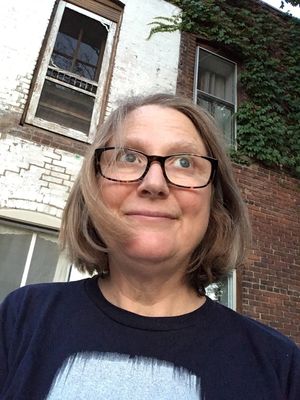
Amy Halloran
creative nonfiction
Amy Halloran is a writer and teacher who lives in Troy, New York. Her love for food, and for the people who grow and make it, led her to write a book about the revival of regional grain production, The New Bread Basket. She writes for Civil Eats, The Crumb, and The Times Union, a Hearst newspaper. To invite people into the practice of writing, she teaches community workshops. As writer in residence at the Hart Cluett Museum, Rensselaer County’s Historical Society, she studies bakeries and women’s labors. This research is part of her next book, about the twinned histories of the modern American loaf and the modern American woman.
Vegetable Kingdom
All winter we cultivate our manias.
We build fires in the stove, urge the kids to fetch wood. Water on the stove simmers and disappears, and the insides of the empty pans are thick with a silt of minerals.
Outside, the ghosts are on the clothesline. All of the people we have been, our effigies, and everyone we might be. All our ancestors are there too. Everyone hangs by their fingertips, and they are so light, the line hardly droops. There I am as an architect. There you are: a dentist. There is my Babcha, the washerwoman, hanging on the rope beside my grandmother who wrote. There I am, teenaged and indecisive. Here I am, the same, though I do have more substance, and less wonder.
Beside me are our children, in life and on the line. They are thick and thin, almost evanescent as they change and grow. I see my eyebrows grow like grass on the bump of my son’s forehead. Your chin shows up on the baby’s jaw. I see details, but I can’t really see who we are. Still, I feed our frenzies and hungers. Popcorn, then soup. Ice cream, then milk.
The laundry dries on racks. We are a snivel, a drip. We drink tea and read seed catalogs. Daytimes, we feel restless and unimportant until we rustle up some dinner: the garden’s food revoked from the freezer. Then later, even if there isn’t a full moon, the dotted Swiss sky makes us feel significant. All that light comes from stars that are gone, long gone.
Nights are cozy. We sleep sausaged into our lives. A snow of possibilities frosts our lids, and we dream of growing. Asian greens? Hubbard squash? Keeper onions as round as softballs. The house turns into a plant. The root cellar grows roots. Stems pop out windows and tickle trees. Flowers bloom but I can’t tell what fruit will grow. Apples, berries, tomatoes?
The dream is so thick it sticks with me all morning. I eat long twirly peppers to shake the day free. I don’t get through many before the night is tucked back into bed. I shuffle the children off to school. They leap into the cold like skydivers. Enthusiasm is their parachute. I take in a few pieces of firewood with the morning paper, and after I feed the fire, I cut out a headline.
When are you going to learn that you can’t ignore the bad stuff?
Seems a bit philosophical for news.
The digital revolution revamps domestic tasks. Are you ready?
What I learned in my family of origin, the article promises, is not going to help me with you in this, our family, our destination.
I put down the paper and fold the clothes, put them in wicker. My clothes, yours. When we first met, we borrowed from each other, delighted we were the same size. Now our wardrobes are discrete. Additionally, we are unemulsified, layers of oil and vinegar. A little pond of floating herbs. Yet we remain loyal subjects to the thrones of home, speaking the navigational languages we learned as children.
A family is a little kingdom. The baby rules us all, and we, the parents, try to rule each other. This is not dominance, but an attempt to maintain a self. Who owes a load of dishes. Who deserves to sleep late.
There is too much competition. I sigh, carry the clothes upstairs. Should I throw them on you? I envy your rest. Do you dream of the plant that is our house?
The stairway is a canyon that catches our steps. Always I think I am going to fall. Will this be the broken leg mistake? I anticipate how I will regret my rush, but it doesn’t slow me, not much. We are bees in a hive, mice in a hole. We have bedrooms. The beds catch us. This is tricky, a description. The pillow cradles my head, the mattress owns more of me than you know. I will never know you like your pillow.
Wearing stripes is beginning to make me feel nauseous, so I give away my striped shirts. You wear stripes, but on you, they don’t vibrate inside my eyes. Solids, stripes, these are our disguises. This is what discourages us.
I know we are not just opposites. I know we are separate, equal and supportive. The kingdom of this house is a lace, a mesh, a net. I race to catch you as you throw yourself down the stairs. Someone was chasing you in your sleep, a meteor-sized beet dressed as a spider. All these years I didn’t know you were afraid.
In the spring, we thaw like dirt.
I am not educated in this landscape. You have known how to sow, and I learn. Still, I remain better at cooking. The boys figure out how to use the ground. They start their own plots, and this summer, they will be selling to supermarkets. I can see them, horse and cart, going up the hill with a wagon full of lettuces.
To me, the dirt gives dinner. I study cookbooks, watch TV chefs. This is how to rock a knife. This is how to salt. This is when. Acid plus sweet. Heat plus sweet, too. Fill the rice pan one inch above the level of the grains.
Of us, there is no cookbook. I could read lessons on marriages, take best-selling advice. Those books talk about people, but they don’t say a word about me and you. Instead, I study our intimacy. I learn by holding up mirrors to my past, and our shared life, the way people used to check for death, watching for breath condensing on the surface of the glass. I know better. Every day I know more.
“ I wrote this piece about 15 years ago, when my kids were little and my husband and I were busy urban homesteading. It was an attempt to capture my amazement about the way things grow, people and plants, and the oddity of being a part of a couple. The title was a riff on the vegetable kingdom, of course, but also, a tip of the hat to our wedding—my husband organized a participatory play and I wrote an opening monologue about a family being a little kingdom. The speaker wore a drapey paper hat and spoke in an elegant, eloquent voice.”