
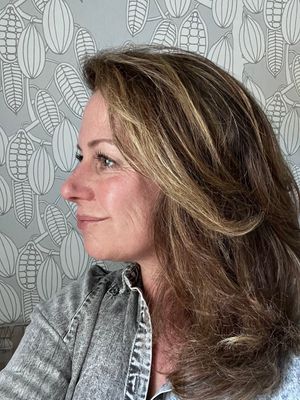
Eileen Dolbeare
creative nonfiction
Eileen Dolbeare is a writer, photographer, and documentary producer living in Niwot, Colorado. Her photography has appeared in Welter Journal, New Plains Review, Sagebrush Review, and Hofstra Windmill, and her poetry is forthcoming in Sand Hills Literary Magazine. She carries a quiet ancestral pull toward Ireland and is completing a Graduate Certificate in Celtic Mythology at Pacifica Graduate Institute.
A Good House Cleaner
I clean. That comes from my mother. My name, too. I'm a junior—Big Eileen and Little Eileen.
An Irish family history is too many kids and never enough clean. Eileen comes after a Kathleen. And then Eileen again. Wild-haired Kathleen MacMahon, who launched from County Clare to New York domestic life, swirls in the family helix.
But Big Eileen was a bad cleaner.
Overload of four kids. Absent husband. Desire for domestic resistance.
She negotiated her mother-load. Logged hours toward a pilot’s license with us in the backseat of a Cessna Skyhawk. Woodworked in the garage, goggles on, with us beside her. Wrote the American curriculum for the International Baccalaureate in English while we were sent out for proper Irish breakfasts with a woman named Bridget and her three daughters, Eileen, Kathleen, and Maureen.
So many cigarettes, her fog of smoke.
But our mountains of laundry. Yellowed toilets. Crumbed carpet. Streaked mirrors. Dusty corners.
I cleaned before I climbed trees, before I called to order my Rocky fan club.
Everything got picked up.
I vacuumed in symmetries, toggling settings for hardwood and medium pile. I discerned the difference between important bills and junk mail. I loved Windex.
I scrubbed out footprints and fingerprints.
I separated and sorted Legos and Army men and checkers and marbles and Barbie shoes and Matchbox cars and the different colored Lite Brite pegs. I put them in their right places.
Of course I pulled everything out from under the couch.
I even went out of my way to straighten and close the little front door of the Betsy Ross dollhouse replica on the sun porch. Betsy Ross was one of seventeen children. Industrious as she was, she would have known her way around lime and lye, bucket and broom.
It wasn’t easy. A tiny round brass doorknob on the left side of the Colonial door, next to slatted doll windows I sprayed with Windex. Too small to pinch the door closed from the outside.
So I would wrap my arms around the whole house, a real armful, and work the door with both hands, one inside and one out, until it was flush with the frame.
My mother never opened report cards. Acknowledged the scholarship. Knew the game’s final score.
You’re a good cleaner, Eileen, she would say, leaving her coffee mug and its ring on the side table. Then she would walk across the perfect tracks I had fluffed into the carpet. I noticed you even closed the door on Betsy Ross’s house.
Now I know the toll of one day’s meals on a kitchen with my own four sons and the assault of a bathroom of boys. But I watch them spritz Windex over toothpasted mirrors.
Still, nothing has ever come close to straightening and closing Betsy Ross’s door in Big Eileen’s house.
The door closed flush. The house in order.
“ My mother was the most alive person I knew, and the hardest to hold on to. Cleaning was one way I tried to keep her house in order when I couldn’t keep her still. This piece took years to write. I think I was trying to get the door to close the way it actually closed: one small, exact motion, with everything underneath it.”