
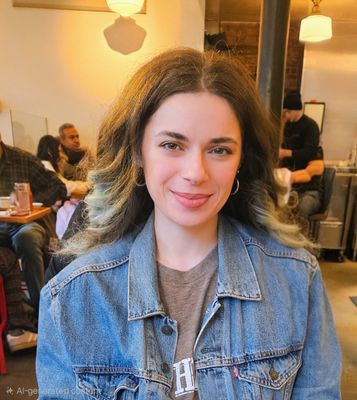
Morrigan Byalin
Contest - Flash Fiction
Morrigan Byalin is a writer and educator from Staten Island, New York. She received her MFA in Creative Writing (Fiction) from Boston University and is pursuing her PhD in English Literature at the CUNY Graduate Center. She is the recipient of the Leslie Epstein Global Fellowship, the Blanche Colton Williams Fellowship, the Audre Lorde Award, and the Mary M. Fay Award in Poetry. She was shortlisted for The /tEmz/ Review’s “London” Prize in Prose (International). Her work has appeared in Bending Genres, Lowestoft Chronicle, Spoon Knife Anthology, and elsewhere. Read more at morriganbyalin.com and follow her on Instagram @morriganbyalin.
Types
The boys and I are discussing girls, and they are asking about types, and they are all listing the same thing essentially, but in different ways. Redheads, one might say; green eyes, the other; short girls, says a short boy; fat girls, says a fat boy. Then they ask me and I say flutists. They ask me what that means, and I say forgive me, it’s pronounced flow-tists but it’s only flute-ists, nothing fancy, just people who play the flute. They want to confirm, to make sure what I am saying is that I like girls who play the flute and I say that is correct. They are angry now, tell me if this some sort of crass joke, to just cut it out, because they aren’t those sorts of guys and I have no idea what they are talking about and so one of them says, flute, and then pantomimes fellatio and I say, oh no, no not at all, no, I’m so mortified, no, I mean literal flutists. Girls who play that woodwind instrument that is not wood: the flute. They tell me that’s not how it works, that flutists aren’t a type, and I ask how they know and they say it’s common knowledge. I have to pick something like curly hair or freckles or brunettes.
Have you ever been in love, I ask them, and they all say no and I say obviously. Obviously you’ve never been in love if you don’t understand the power of a flutist. And it doesn’t have to be a flutist. It can be an oboist or a violinist or a pianist, and they laugh because pianist sounds like penis and I say guys I’m serious. It could be trombonist or a clarinetist or a harpist and at this point I’m just naming instruments because I’m starting to worry they’ve never seen any. Maybe your type is a girl who plays the triangle, and you might say, ugh, the triangle, it’s so easy, I could do it, but could you? Sure, it’s easy to strike the thing, but would you know when to come in? Can you read sheet music? Have you honed your inner ear?
Maybe you like legs, they say, or breasts, and I say this is the problem. I’m some kind of freak for liking flutists, but here you are carving up girls up like Thanksgiving turkey, and they say, nah man, we don’t like legs or breasts—we like blondes and small noses and gym rats and goth chicks and girls who bake bread and want kids and dance like crazy at parties—we are just saying breasts and legs are viable options. You can’t just like flutists; there aren’t enough flutists in the world. And I say that’s dumb because I’m not starting a collection, I just need one flutist, to have and to hold.
I keep repeating flutists because what else can I say? Eleanor? Eleanor Gunsberger from the tenth grade? Eleanor who was first flute and wore black pants and a white shirt and stood up and played Debussy’s Syrinx. Eleanor the only true soloist of the evening, and she was perfection even though later she said she sounded breathy and was embarrassed. I played the cello but wasn’t on stage because they only needed two cellos and I didn’t make the cut. They said I was third in line and really quite good but they only needed two so I didn’t make the cut. And maybe if I was first cellist or even second cellist she would have paid attention to me because we’d both be aficionados, we’d both love Debussy. We’d talk about the Belle Époque and how 1913 is really the last year when anything can be called classical because it’s basically the 1800s but everything after is modern and always will be.
At least I got to sit in the audience in a white shirt and black pants so I could later pretend I was in the orchestra, which I am, I just happened to not make the cut, and if anyone doubted me I could show them my calluses and say, look I work hard, I practice, I suffer, I know music and I want this so bad. I sat in the first row, saw her play and enter that trance and almost sway but catch herself because she’s not some head-bobbing jazz musician, she’s a classically-trained flutist and after tenth grade she’d leave the school and go somewhere for girls like her, a school full of musicians, probably dozens of flutists who could all be my type but the boys are right, they’re not, it’s just Eleanor. I remember her standing on stage with her Yamaha Intermediate Flute, and she had hair of some color and eyes of some color and height and width and all sorts of other dimensions, but I couldn’t remember any of them.
And isn’t that okay, I beseech the boys who are my friends. Isn’t music enough?
They all shake their head, apologetic. Sorry man, but it isn’t enough. Not hardly.
“ ‘Types’ was inspired by Donald Barthelme's famous short story ‘The School.’ A writer friend of mine read it aloud (drunkenly) while explaining Barthelme's ethos that one should make the pattern, then break the pattern. This was my first attempt at breaking the pattern. Also, I played the flute in my school orchestra for four years, and I wasn't about to let that experience go to waste.”