
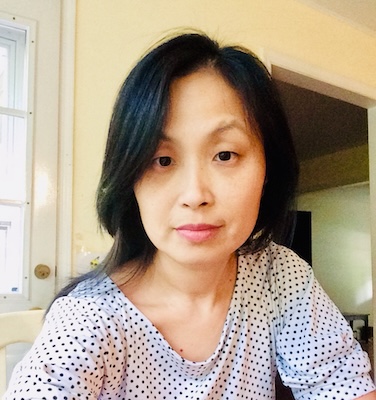
Ann Yuan
fiction
Writing from Long Island, NY, Ann Yuan was a finalist for the Oxford Flash Fiction Prize 2025. Her fiction has appeared or is forthcoming in Gone Lawn, MoonPark Review, Oyster River Pages, Hawaii Pacific Review, Eclectica Magazine, Bending Genres, Flash Fiction Magazine, and elsewhere. Her work has also been included in the Overheard anthology and Iridescence anthology. You can find more at annyuanwriting.com.
A Sheer Drop of Three Thousand Feet
Grandma remembers everything. It’s not hyperbole. In her village, she was the first woman to learn how to read. It’s not hyperbole. She remembers her teacher, a bony man with a goatee, reciting Tang poetry in a singing voice. She remembers the welts on her palm left by his bamboo ruler. She remembers that high noon, the blinding sunlight and the buzzing cicadas. A yellow dog chased her all the way to the foot of the mountain, where women wrung sheets and scrubbed cloth diapers in the creek. She told them the news of the war. They stopped, listened, then sat down to breastfeed their babies.
When Japanese bombers raided Sichuan, my mother was still an infant. Grandma wrapped her in a sling and rushed toward the shelter dug into the mountain. The planes slid overhead, a terrible howl of metal birds. She saw a pilot turn his head and look down at her from the cockpit. I asked her if she was scared at that moment. She said, “I don’t remember.”
My mother didn’t give a whimper the entire time inside the cave. She was not a girl who cried easily, but when she grew up, she refused to go to school. Grandma took her hand and pulled her to the well in the center of the village. She pointed to the dark hole and told my mother that if she didn’t learn to read and write, she would end up like the newborn girls who were drowned there before they had a chance to breathe on their own.
Grandma remembers everything. She remembers the smell of vomit, cigarettes, and the Pacific Ocean inside the ship’s dark cabin; she remembers the first time she heard the name Tiffany Blue was when Grandpa painted the counter of their dry cleaner in Queens. Despite washing a thousand suits each year, Grandpa never wore one himself. He spent two months’ rent on a navy wool suit and hung it in the closet for special events, with a mothball in each pocket. Years later, he wore it to his funeral.
After Grandpa died, my mother wanted to drop out of college to help in the shop. Grandma gazed at her and said, “Mind your own business.” She sat on a stool by herself, put on her bifocal glasses, and mended other women’s dresses. Somebody pounded the door. She looked up and smiled, one hand feeling for the pistol in the sewing basket under the counter.
Grandma has lots of cavities, but she still loves sweets. She remembers the soft, fragrant mooncakes my mother bought with her first salary, which was only half the amount the American girls in her department earned. She remembers my mother answering the door for what’s-his-name, how my mother’s white sandals clicked on the floor and her skirt blossomed in the breeze like a water lily, and then how she locked herself in the bathroom and sobbed. The moxibustion smoke slithered upward, coiling around her bruised arms as if she were a summer barbecue. “It’s for the best,” Grandma said. “It’s for the best.”
Grandma remembers everything. That is hyperbole. For the last ten years, her only goal has been to live to one hundred—a number symbolizing fulfillment and auspiciousness. That is also hyperbole. She’ll yell at my uncle if he doesn’t bring her snacks on time. She complains about tasteless food and smelly water. She keeps saying her doctor treats her like a lab rat until the poor guy shuts down his tablet and runs out of the room. We hope he didn’t cry.
Six months before Grandma’s one-hundredth birthday, my mother died of a brain tumor. My uncles decided not to tell Grandma. Reason one: to spare her the grief. No one can predict her reaction, and no one wants to take responsibility for the worst possibility. Reason two: if the disease keeps eating her brain, soon she will meet my mother, and she will know it anyway.
I see the point. I just don’t understand why my mother had to skip the line. Didn’t she know Grandma is closer to heaven than anyone else in this family?
Grandma is happy at her birthday banquet. She claps and sings with her great-grandchildren. She knows everyone’s zodiac sign. She rubs two fingers together, showing us the heavy texture of Grandpa’s navy suit. At one point, she realizes that my mother is missing. She mutters, head wobbling, “What a forgetful girl.” We all tense up. Before we come up with an excuse, she closes her eyes and recites Li Bai’s poem that she learned at the age of six—a waterfall hangs, a sheer drop of three thousand feet. Everyone knows that is hyperbole.
“ Human memory is a tricky thing. A pianist with late-stage dementia can still play Für Elise without any glitch, but he can’t recall his wife’s name. I often wonder whether we selectively remember the past or our brains instinctively filter the memories to spare us pain. This story, while fictional, draws on my own family history. My father’s family lived in Sichuan province, southwestern China, during World War II, and they witnessed Japanese bombers flying overhead. ”