
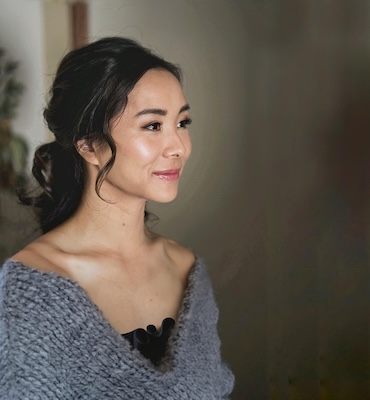
Mizuki Yamamoto
fiction
Mizuki Yamamoto is a writer from Japan, currently living in the foothills of the Rocky Mountains with her half moon and two very spoiled farm dogs. Mizuki’s writing has appeared in or is forthcoming at SmokeLong Quarterly, The Forge, Flash Frog, The Citron Review, Does it Have Pockets? and elsewhere. Mizuki’s work will appear in Best Microfiction 2026. She has also been nominated for Best of the Net, Best Small Fictions, Best American Short Stories, Best American Essays, and the Pushcart anthologies.
Mars is not as dry as they told us
Mars is not as dry as they told us, though it’s not like it rains. And from what I’ve seen, it’s flatter than you’d believe. The horizon here is long and uninterrupted. It’s easy to imagine maybe the planet isn’t even round at all. At least, these are small jokes we crack amongst ourselves in the hush of dark when the sun spins away. Some things don’t change, even on a different planet.
I still recall Earth—our home, which, from what I saw on my way up here, is very round and very blue. Like a marble, as someone said long ago. And somewhere on its surface, two-hundred million kilometers away from me, my grandfather is dying. From here, it’s just a sparkling speck. I wonder for how long we’re allowed to call it home.
My mom phones me in the middle of the Martian night. It’s nine in the morning for her in Yokohama. Behind her, the sun is shining—its face familiar and strange at the same time. A lizard stuck on the wall by the porch flickers its tail. Pigeons coo from the telephone lines. Something about that sound twists my chest up, more now than ever. Thrushes and buntings sing from the woods behind the house. Early summer frogs open their mouths in chorus for the soon-to-come rain season.
Mom’s face floats like an eerie ghost in my palm as she speaks, her voice crisp but distant as she tells me there’s no need for me to travel back home. Grandfather isn’t conscious enough for a proper goodbye, anyway. All that’s keeping him tethered is the drip of the IV fluid. He’s halfway gone already. When I try to interrupt her, she says, we’re all halfway gone though, aren’t we?
Her face is a windless lake. Mom always had a Zen-nihilistic view on life, in a way that scared Dad and me sometimes. She used to make us promise we’d never keep her on her deathbed longer than necessary. When it’s time to pull the plug, pull it. Promise?
We never did.
Now, she says, you should keep doing what you need to do up there. Science, exploration. For humanity’s future, right?
She doesn’t really mean it.
Grandfather was a taciturn, serious man, but he always tried to make me laugh. Once, he bought me a raffle ticket at a department store outside of Hamamatsu where they used to live by the sea. It was the kind where I got to spin a giant wheel and a ball would roll out. I must have been six or so at the time. The handle for the raffle wheel was almost too high for me to reach at its peak. I stood on my tippytoes and cranked it down hard, the balls making a crashing sound, like waves. I can’t remember what we won, but afterwards, he carried me on his shoulders like I was the prize, parading me around the mall. I waved to everyone from up high like a queen.
Mom is talking about the loquat tree now. The one that sprouted in the garden when I was in first grade. A stray seed I discovered after nibbling on a fallen fruit I’d found on the path back from school. It was mostly sour with just a faint pretense of sweetness. I’d buried it in secret in our tiny garden, a plot just slightly bigger than two futons laid side by side. It grew into a sapling as I graduated middle school. A glossy young tree of ambitious growth when I left for university in the United States. Four years ago, after I’d made it here on my mission, she said it fruited for the first time. She sent me a video of the small golden fruits nodding like gleaming heads in the breeze, limbs brushing against the house.
I see the tree again now as she walks me around the garden in her palm. The vivid vision collides against the darkness around me. The green is dense, viridescent, a prolific overgrowth climbing into my eye sockets. It almost hurts. Clouds absurdly bright and white, untarnished by dust. The sky blindingly blue—all impossible colors and hues here. Mom holds the camera up to the ends of a branch. A blushing bud swells between her fingers. In the fall, these will become fruit, she says. I nod.
Without taking another breath, she asks me if I’m still thinking about having children. Dad and I are getting old too, she says. She wants her grandchildren to remember them, wants to take them to Disneyland and to the cherry blossom festival and to see the fireworks over Lake Sagami. I say, yes, under my breath. The wind outside screams. Beyond my mother’s face, the reinforced glass window of the habitat glints—the rust-blue dawn edges against the swirling horizon.
I don’t tell her how high the maternal mortality rate is here. Or how challenging it is for newborns to survive in this atmosphere, however shielded within the domes of the colony. That it’s become even harder lately for Martian-born to be granted an Earth visa. The blue planet is already overflowing, and they don’t welcome outsiders. Same anxieties from generations before, different manifestations. I don’t tell her the next civilian passenger-shuttle back to Earth isn’t for another ten years anyway, although I’m certain she’s looked that up already.
I weigh the distance between us on the tip of my tongue with words I don’t say. Two hundred million kilometers. One whole decade. She’ll be seventy-two by then. Our conversation now will be ancient history, just an electric signal lost into the ether. My grandfather will be long gone, the tears on my cheek dried to nothingness. And this dust-red planet will look much the same as it does now. Still, nothing will grow outside of the habitats. Not even a sprout. Not even the zealous roots of a wildling tree.
Back in the kitchen, Mom puts me down on the countertop. I want to ask her what she’s going to make for lunch, but she says she’s got to go now. They’re headed to the hospital to bring my grandfather back home so he can die in his own bed. Back home, he won’t have an IV. Without it, he’ll be free to go on his own time. Quickly enough, with a view of the field outside the house, and the trees.
Finish what you need to do and come home, okay?
I nod, even though there’s no such thing as an end to this mission, and tell her I love her. Since our distance, Mom’s gotten less shy about saying, out loud, she loves me too. It’s not very Japanese of us, but when all you can think about is how far away someone is, it’s easy to lose your inhibition about certain things.
We hang up before we can see each other’s reddening eyes. In the silence, the tether comes undone and I feel something within me unravel and float into space. Life goes on. The planets revolve, the sun rising on every one.
What holds us to life is tenuous. Fragile. Just a thin drip. I think of my own bed back at home. Mom’s probably kept my room tidy all this time. In my mind, my head hits the pillow and I pull the quilt up to my chin—the one my grandmother had embroidered before Mom got into quilting herself. I’d counted sixty-seven fish swimming across the patchwork of blue, all of different shapes and sizes. From the hallway, Mom hums a lullaby.
I drift off into the gold-red embrace of a loquat planet.